Katherine Swynford by Jeannette Lucraft
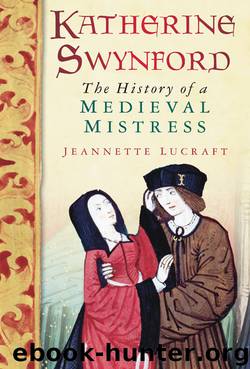
Author:Jeannette Lucraft
Language: eng
Format: epub
Tags: Katherine Swynford: The History of a Medieval Mistress
ISBN: 9780752468280
Publisher: The History Press
Published: 2011-09-07T04:00:00+00:00
CHAPTER 5
Construction of Identity
The documentary evidence for Katherine’s life is limited to the writings of monks. Probable scenarios for Katherine’s upbringing and education can be uncovered using information known about other medieval notables at court or throughout the country. Attitudes towards Katherine can be gleaned from the lack of information that is available about her. But the issue of how Katherine viewed herself, or how she wished others to view her, cannot be uncovered from these sources. Personal letters, a journal, or even her testament would be crucial sources here, but none of these is extant.
This whole issue is, of course, a troublesome concept. How does one capture the essence of another’s identity as she saw it and wished it to be seen? This is made more problematic because of Katherine’s gender and status. Her sex means that we have no accounts of her direct actions; her sexual conduct and marginal role as mistress further this lack of information – she did not play a public role that led to documentation. The nature of the medieval period, and the means by which documents survive, means that we have no diary, letters, or personal accounts of any kind that inform us of Katherine. We are in general heavily reliant on wills with regard to the investigation of people’s beliefs, customs and desires, but even here there remains the problem of the scribe and the common model that he followed. People did not write their own wills, merely gave instructions to a scribe, and he transposed these instructions in standard form. However, the clearest indication of any self-perception, or desire to promote a certain image, would have come from Katherine’s testament. Unfortunately, and frustratingly, this is not extant. She does appear to have written a will. The chapter accounts of Lincoln Cathedral record that in 1403, the year of Katherine’s death, the Clerk of the Common together with one of the chapter messengers journeyed to Liddington to confer with the Bishop, Katherine’s son Henry Beaufort, concerning the probate of her will. Puzzlingly, Katherine’s will was not copied into Beaufort’s episcopal register, nor is any copying apparent in the Prerogative Court of Canterbury or the Lincoln Consistory Court.1 Was there some reason why Henry did not record its details, or was it merely a mistake, a forgotten instruction?
A further problem is to what extent there was a sense of self in the fourteenth century. Modern times are focused on the expression of the individual. ‘Self’ is all: we do things generally because we want to; personal desire is seen as enough to override problems or constraints to achieve what we want; self-belief is the key to success. Was this a possible, or even a desirable, scenario for a medieval woman? Were the ideas of self-belief and personal goals present in medieval society? Interpretations of sources for this information are nuanced. What we see as important now in medieval texts and art may have been of little significance then, and the contrary position is
Download
This site does not store any files on its server. We only index and link to content provided by other sites. Please contact the content providers to delete copyright contents if any and email us, we'll remove relevant links or contents immediately.
Fanny Burney by Claire Harman(26723)
Empire of the Sikhs by Patwant Singh(23204)
Out of India by Michael Foss(17022)
Leonardo da Vinci by Walter Isaacson(13509)
Small Great Things by Jodi Picoult(7328)
The Six Wives Of Henry VIII (WOMEN IN HISTORY) by Fraser Antonia(5608)
The Wind in My Hair by Masih Alinejad(5189)
A Higher Loyalty: Truth, Lies, and Leadership by James Comey(5089)
The Crown by Robert Lacey(4935)
The Lonely City by Olivia Laing(4933)
Millionaire: The Philanderer, Gambler, and Duelist Who Invented Modern Finance by Janet Gleeson(4602)
The Iron Duke by The Iron Duke(4466)
Papillon (English) by Henri Charrière(4380)
Sticky Fingers by Joe Hagan(4317)
Joan of Arc by Mary Gordon(4211)
Alive: The Story of the Andes Survivors by Piers Paul Read(4151)
Stalin by Stephen Kotkin(4065)
Aleister Crowley: The Biography by Tobias Churton(3727)
Ants Among Elephants by Sujatha Gidla(3532)
